
IELTS Writing Task 2 is where more test-takers lose marks than in any other section of the exam.
That statement surprises a lot of people. Listening trips up candidates with fast accents and tricky question formats. Reading creates time pressure that catches even strong English users off guard. But Writing Task 2 — a 250-word-minimum academic essay completed in 40 minutes — is where the gap between Band 6 and Band 7 most often lives, and where misunderstanding what examiners want costs the most points.
The frustrating part is that most of those lost marks are preventable. Not with more vocabulary drilling or more grammar study — but with a clear understanding of what IELTS Writing Task 2 is actually asking for, how it's assessed, and how to structure your response to meet those criteria every single time.
This is that guide. And at the end, you'll see exactly how Linguatude helps you put these strategies into consistent, scored practice.
Understanding What IELTS Writing Task 2 Actually Is
IELTS Writing Task 2 is an academic essay task. You're given a prompt — typically presenting an argument, a problem, or a point of view — and asked to write a response of at least 250 words in approximately 40 minutes. Task 2 carries more weight than Task 1 in your overall Writing band score, which is why it demands the majority of your preparation energy.
There are several common Task 2 question types you need to be able to recognize and respond to correctly:
Opinion / Agree or Disagree: Do you agree or disagree with a given statement? To what extent?
Discussion: Discuss both views and give your opinion.
Problem and Solution: What are the causes of this issue, and what measures could be taken to address it?
Advantages and Disadvantages: What are the benefits and drawbacks of this development?
Double Question: Two separate questions must both be addressed in your response.
Identifying the question type before you start writing is a non-negotiable first step. A response that perfectly addresses the wrong question type will score low on Task Achievement regardless of how good the English is.
The Four Criteria Examiners Use to Score Your Essay
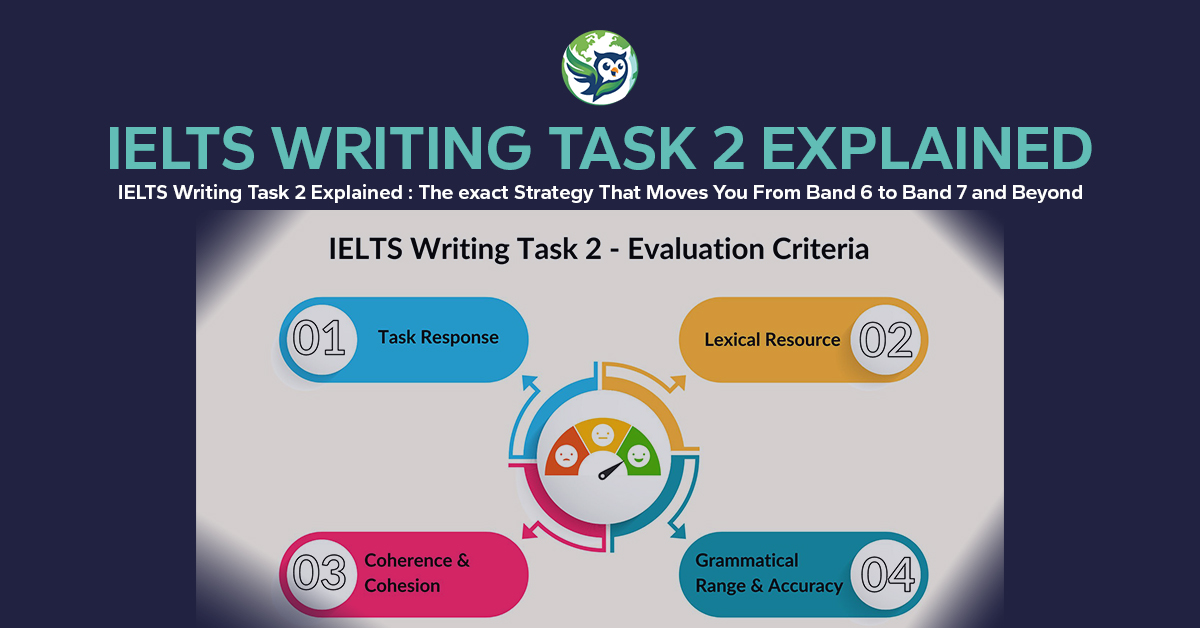
Every IELTS Writing Task 2 response is scored across four equally weighted criteria. Understanding these isn't optional — it's the foundation of every effective IELTS essay writing strategy.
1. Task Achievement
Did you fully answer the question? Task Achievement assesses whether your response addresses all parts of the prompt, presents a clear position, and develops ideas with relevant support. A common mistake: writing a thorough, well-argued essay that doesn't directly answer what was asked. This single error can limit your score to Band 5 or 6 regardless of your language ability.
2. Coherence and Cohesion
Is your essay logically organized and easy to follow? Coherence refers to the overall logical flow of your argument. Cohesion refers to how well your sentences and paragraphs connect — through appropriate use of linking words, pronouns, and reference. Overusing basic connectors like 'firstly,' 'secondly,' and 'in conclusion' is one of the most common IELTS writing tips instructors give — because doing so mechanically actually lowers your score.
3. Lexical Resource
How wide and precise is your vocabulary? Examiners look for a range of vocabulary used accurately and appropriately — not just high-level words used incorrectly. Lexical errors that distort meaning hurt more than using simpler, accurate vocabulary. This criterion also rewards your ability to paraphrase the question's language rather than copy it word for word.
4. Grammatical Range and Accuracy
Do you use a variety of grammatical structures accurately? This criterion rewards complexity — using complex sentences, relative clauses, conditionals, passive constructions — while penalizing frequent errors that impede communication. Perfect use of simple structures will cap your score. Ambitious attempts at complex structures, even with some errors, tend to score better.
A Reliable Structure for IELTS Writing Task 2
One of the most practical IELTS writing tips for any task type is having a reliable essay structure you can apply consistently. Here's the framework that works across most Task 2 question types:
Introduction (2–3 sentences): Paraphrase the question topic, then clearly state your position or outline the points you will discuss. Do not copy the question language directly.
Body Paragraph 1 (4–6 sentences): Present your first main point. Begin with a clear topic sentence. Develop the idea with explanation and a specific example or evidence. End with a connecting sentence that flows into the next paragraph.
Body Paragraph 2 (4–6 sentences): Present your second main point using the same structure — topic sentence, development, example, link forward.
Conclusion (2–3 sentences): Summarize your main points and restate your overall position without introducing new information.
This four-paragraph structure is not the only valid approach — but it's the most consistently reliable one for hitting the Band 7 benchmark. It ensures you have enough space to develop each idea properly, demonstrates clear organization, and leaves you with enough time to write and briefly review within 40 minutes.
The Most Common IELTS Task 2 Mistakes — and How to Stop Making Them
Even test-takers with strong English make the same avoidable errors in Task 2. Recognizing these patterns in your own writing is one of the fastest routes to a higher score:
Not answering all parts of the question. Many prompts contain two distinct elements. Missing one — even partially — directly limits your Task Achievement score.
Using memorized phrases and templates. Examiners are trained to spot pre-learned 'essay phrases.' Overusing them signals a lack of authentic lexical resource and hurts your Lexical Resource score.
Writing underdeveloped body paragraphs. A topic sentence followed by one example and nothing else is insufficient development. Each paragraph needs a clear idea, explanation, and specific support.
Spending too long on Task 1. Task 2 is worth more. If you run out of time and submit an incomplete Task 2 essay, the mark penalty is significant.
Repeating the same words and sentence structures. Even if each sentence is grammatically correct, repetition limits your Lexical Resource and Grammatical Range scores. Variation matters.
Knowing the mistakes is only the first step. The real skill is being able to catch them in your own writing under timed conditions — which only comes through deliberate, feedback-informed practice.
How Linguatude Builds Your IELTS Writing Task 2 Skills Systematically
Understanding what makes a strong Task 2 response is one thing. Consistently producing one under exam pressure is another. That gap — between knowing the criteria and applying them in real time — is exactly where preparation makes the difference.
Linguatude is a language learning app built specifically around standardized English tests including IELTS. For Writing Task 2, it provides:
Personalized practice prompts matched to your current proficiency level and target band score.
Structured writing exercises that target each of the four scoring criteria individually — so you can isolate and improve specific weaknesses.
Vocabulary building modules focused on the academic and topic-specific language most frequently rewarded in Task 2 responses.
Timed practice conditions that mirror the real exam — building the mental stamina and pacing control that exam day demands.
Progress tracking that shows exactly where your writing is improving and what still needs work — so your preparation time is always going to the right place.
Linguatude doesn't promise you a Band 7 in a week. But it does give you the structure, the practice, and the specific IELTS essay writing skills development that consistently moves test-takers up through the band descriptors — at a pace that reflects how you're actually progressing.
Your Band 7 Is a Skill, Not a Gift
High scorers in IELTS Writing Task 2 aren't necessarily the most naturally gifted writers. More often, they're the ones who understood the assessment criteria early, practiced with those criteria in mind, and built a reliable process they could execute under pressure.
That process is learnable. The Band 7 you need — for your university application, your professional license, your visa pathway — is achievable with the right preparation. Not just more practice, but smarter practice: targeted, structured, and built around what examiners actually reward.
Linguatude is built to be that preparation. Let it take you from where you are to where you need to be — one well-crafted essay at a time.